Types of Companies in India: Complete Guide to Company Structures
Choosing the right business structure is one of the first important decisions an entrepreneur needs to make when starting a business in India. The structure you choose can affect ownership, liability, compliance requirements, taxation, fundraising and the way your business operates.
India has several types of companies and business structures, each designed for different purposes. A small business owner may have different requirements from a startup planning to raise investment, while an organisation established for charitable or social purposes may require a different structure altogether.
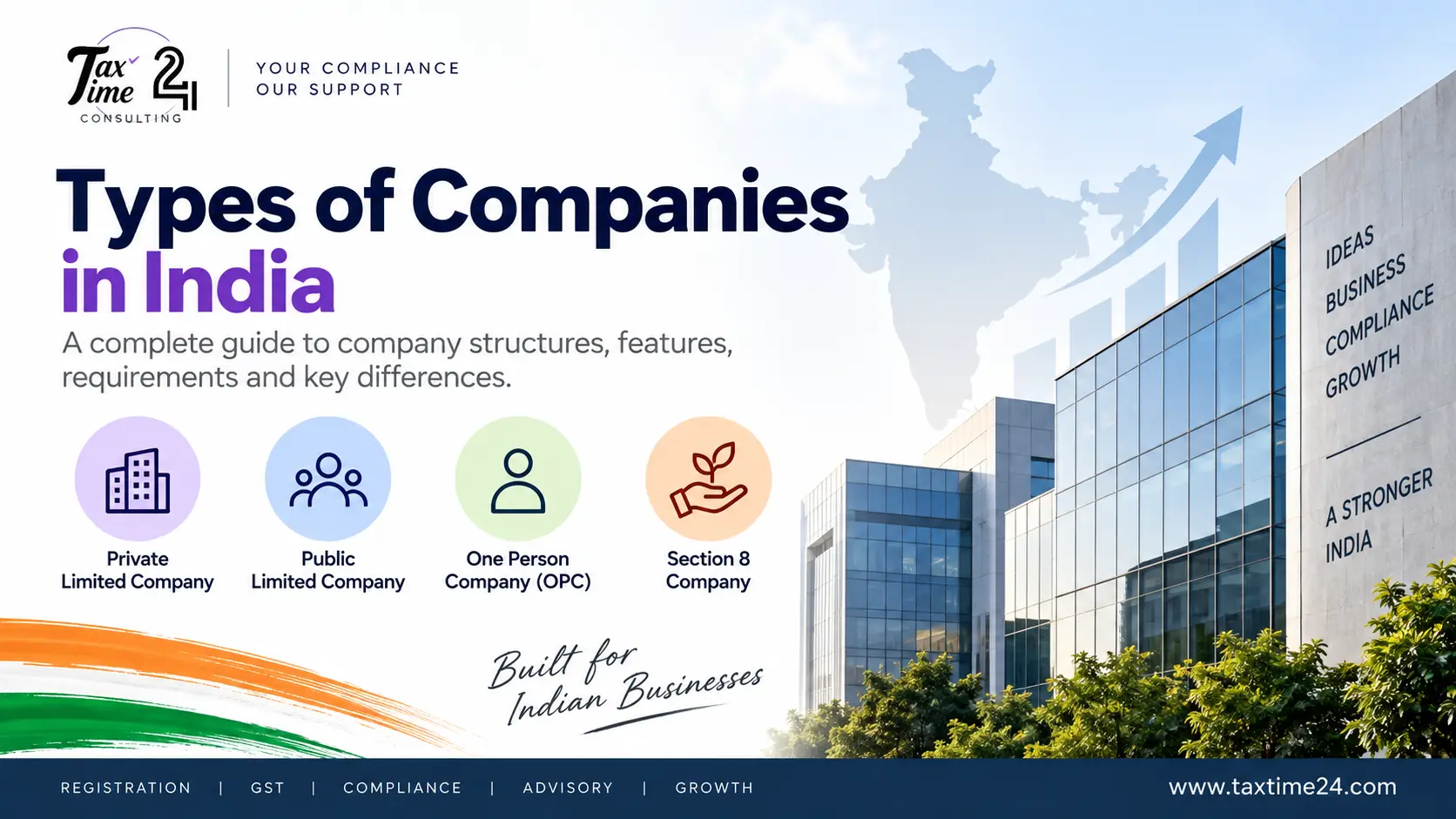
Under the Companies Act, 2013, companies can be formed as public companies, private companies and One Person Companies, subject to the applicable legal requirements.
This guide explains the different types of companies in India, their key characteristics, how they differ and what factors you should consider before choosing a structure.

What Is a Company?
A company is a legal entity incorporated under applicable company law. Once incorporated, the company has a legal identity separate from its members, subject to the provisions applicable to that type of company.
A company can own property, enter into contracts, maintain a bank account and carry out business activities in its own name.
The Companies Act, 2013 provides the primary legal framework for companies incorporated in India. The Ministry of Corporate Affairs (MCA) administers the corporate regulatory framework and the MCA portal is used for various incorporation and compliance filings.
Types of Companies in India
Companies can be classified in different ways depending on factors such as the number of members, liability, ownership, purpose and whether securities are listed.
Some of the commonly discussed company structures in India include:
- Private Limited Company
- Public Limited Company
- One Person Company (OPC)
- Section 8 Company
- Company Limited by Shares
- Company Limited by Guarantee
- Unlimited Company
- Producer Company
- Nidhi Company
The practical suitability of each structure depends on the nature and objectives of the organisation.
Let’s understand the major types in more detail.
1. Private Limited Company
A Private Limited Company is one of the most commonly used corporate structures for businesses in India.
Under the Companies Act, a private company can be formed by two or more persons. The Act also places restrictions on the transfer of its shares and the number of members, subject to the applicable provisions.
A Private Limited Company is commonly considered by entrepreneurs who want to operate through a separate corporate entity and may require a structure suitable for bringing in additional shareholders or investors.
Key features of a Private Limited Company
- Minimum two members are generally required.
- It has a separate corporate identity.
- Shareholders’ liability is generally limited to the amount unpaid on their shares.
- Transfer of shares is subject to restrictions applicable to private companies.
- It can have up to 200 members, subject to the Companies Act and applicable exclusions.
- It is subject to ongoing ROC and other applicable compliance requirements.
- It can be suitable for businesses planning structured growth or external investment.
If you are considering this structure, the incorporation process generally involves name approval, preparation of incorporation documents and filing the required forms with the MCA.
Related resource: If the company will be registered for GST, see our guide on GST Registration for Private Limited Companies.

2. Public Limited Company
A Public Limited Company is a company that is not a private company and is subject to the requirements applicable to public companies under the Companies Act.
A public company can be formed by seven or more persons under Section 3 of the Companies Act, 2013.
Public companies can be relevant for businesses that require a broader ownership structure and, where applicable, access to public capital markets.
Key features of a Public Limited Company
- Minimum seven members are required for incorporation.
- It has a separate legal identity.
- Shareholders generally have limited liability.
- It can have a large number of shareholders.
- Additional corporate and regulatory requirements apply.
- A public company may be listed or unlisted depending on its circumstances and applicable regulations.
Public companies generally involve more extensive governance and compliance requirements than smaller privately held corporate structures.

3. One Person Company (OPC)
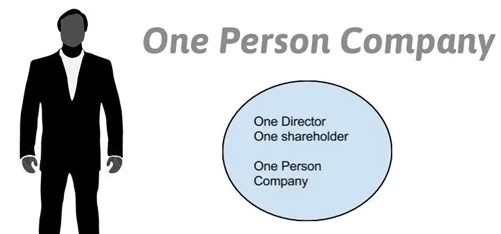
A One Person Company (OPC) allows a single person to form a company.
Section 3 of the Companies Act, 2013 specifically provides for formation of an OPC by one person, with the OPC being a form of private company. The incorporation documents must also provide for a nominee who can become the member in the circumstances specified under the law.
Key features of an OPC
- One person can incorporate the company.
- It has a separate legal identity.
- It provides a corporate structure for a single-member business.
- A nominee is required as prescribed under the applicable rules.
- The company remains subject to applicable corporate compliance requirements.
An OPC can be considered by an entrepreneur who wants a corporate structure while initially operating as a single member.
4. Section 8 Company
A Section 8 Company is established for promoting specified objectives such as charitable activities, education, social welfare, environmental protection, research or other purposes covered by Section 8 of the Companies Act.
Unlike a conventional commercial company formed primarily to distribute profits to its members, a Section 8 Company operates with restrictions relating to the application of its income and profits.
Key features of a Section 8 Company
- It is established for specified charitable or socially beneficial objectives.
- Its income and profits are applied towards its objectives.
- It operates subject to the conditions imposed under Section 8 and applicable regulations.
- It can be used for eligible non-profit activities.
- It has corporate legal status while operating for its stated objectives.
A Section 8 Company is therefore different from a normal commercial company and should be considered only when the organisation’s objectives fit the applicable legal requirements.

5. Company Limited by Shares
A company limited by shares is one where the liability of its members is limited to the amount, if any, unpaid on the shares held by them.
This is a common basis for corporate structures where ownership is represented through shares.
For example, if a shareholder has subscribed to shares and an amount remains unpaid, the liability can generally be limited to the unpaid amount, subject to the applicable provisions.
This concept is relevant when understanding how shareholder liability operates within companies.
6. Company Limited by Guarantee
A company limited by guarantee is a company where members’ liability is limited to the amount they undertake to contribute to the assets of the company if it is wound up.
This structure can be used in certain organisations where members undertake a specified guarantee rather than holding ordinary share capital in the same manner as a company limited by shares.
The appropriate structure depends on the organisation’s objectives and legal requirements.
7. Unlimited Company
An unlimited company is a company where there is no statutory limit on the liability of its members.
The Companies Act, 2013 defines an unlimited company as a company not having any limit on the liability of its members.
This structure is considerably different from limited-liability company structures and should be considered only after understanding the potential implications for members.
8. Producer Company
A Producer Company is a corporate structure designed for eligible producer-related activities and is governed by specific provisions of the Companies Act.
Producer Companies can be relevant to groups involved in activities connected with primary produce, including agriculture and related sectors, subject to the applicable legal requirements.
Because Producer Companies have specific eligibility and compliance requirements, professional advice can be useful before incorporation.
9. Nidhi Company
A Nidhi Company is a specific type of company governed by provisions of the Companies Act and applicable rules.
Its principal objective relates to cultivating the habit of thrift and savings among its members and accepting deposits from, and lending to, its members subject to the applicable legal framework.
Nidhi Companies have specific regulatory conditions, so they should not be treated as a standard alternative to a Private Limited Company.
Private Limited Company vs Public Limited Company vs OPC
Understanding the differences between the most commonly considered corporate structures can make the decision easier.
| Feature | Private Limited Company | Public Limited Company | OPC |
|---|---|---|---|
| Minimum members | 2 | 7 | 1 |
| Separate legal identity | Yes | Yes | Yes |
| Ownership | Private | Public structure | Single member |
| Share transfer | Restricted as applicable | Generally less restricted | Subject to applicable provisions |
| Suitable for | Growing privately held businesses | Larger ownership structures | Single-member businesses |
| Corporate compliance | Applicable | Applicable, generally more extensive | Applicable |
| Investment structure | Suitable for private investment | Can support broader ownership | More limited |
Note: This table provides a simplified overview. Actual requirements depend on the Companies Act, rules, applicable regulations and the company’s specific circumstances.
How to Choose the Right Type of Company?
There is no single company structure that is suitable for every business.
Before incorporating a company, consider the following factors.
1. Number of owners
If you are starting alone, an OPC may be one structure to consider.
If there are two or more founders, a Private Limited Company may be considered depending on the business objectives.
For larger ownership structures, a Public Limited Company may be relevant.
2. Business objectives
Consider what you intend to achieve with the organisation.
For example:
- Commercial business
- Startup
- Investment-oriented business
- Social or charitable activity
- Producer-related activity
- Member-based organisation
The purpose of the organisation can influence the appropriate structure.
3. Funding and investment requirements
If you expect to bring in investors, issue shares or expand the ownership structure, the company’s capital and ownership framework become particularly important.
A business planning significant investment should consider its future funding requirements before choosing a structure.
4. Compliance requirements
Different corporate structures have different legal and compliance obligations.
Before incorporation, consider:
- ROC filings
- Financial statements
- Annual returns
- Board and shareholder requirements
- Director-related compliance
- Tax compliance
- GST requirements where applicable
Choosing a structure only because the initial registration appears easier can create problems later if the structure does not match the business’s long-term requirements.
5. Liability
One of the major reasons entrepreneurs consider corporate structures is the distinction between the company and its members.
However, the exact scope of limited liability depends on the applicable law and circumstances.
It is therefore important to understand the liability structure before incorporation rather than assuming that every company automatically provides the same level of protection.
Documents Generally Required for Company Registration
The exact documents required can vary depending on the company structure, directors, subscribers, registered office and other circumstances.
Commonly required information and documents may include:
- PAN and identity proof of subscribers/directors
- Address proof
- Passport-size photographs where applicable
- Digital Signature Certificates (DSC)
- Director-related information
- Registered office address proof
- No-objection documentation where applicable
- Proposed company name
- Details of business activities
- Memorandum of Association (MOA)
- Articles of Association (AOA)
- Other declarations and forms required for incorporation
For a more detailed checklist, see our guide to required documents for companies.
Company Registration Process in India
Although the exact process can vary depending on the company structure, incorporation generally involves several important stages.
Step 1: Decide the business structure
Determine whether a Private Limited Company, OPC, Public Limited Company or another structure is appropriate.
Step 2: Select a company name
Choose a suitable name and check its availability and compliance with applicable naming requirements.
Step 3: Arrange required documents
Collect identity, address and other incorporation documents for the proposed directors and subscribers.
Step 4: Obtain Digital Signature Certificates
The required individuals may need DSCs for electronic filing.
Step 5: Prepare incorporation documents
The required incorporation documents, declarations and constitutional documents are prepared.
Step 6: File the incorporation application
The relevant application and linked forms are submitted through the MCA system.
Step 7: MCA review and processing
The application is reviewed by the relevant authorities. Additional information or resubmission may be required if there are issues with the application.
Step 8: Certificate of Incorporation
Once the incorporation application is approved, the company receives its Certificate of Incorporation.
The exact forms, process and requirements can change, so applicants should verify the current MCA requirements at the time of filing. The MCA currently operates its company filing system through its V3 platform and continues to publish updates relating to company forms and incorporation.
Compliance After Company Registration
Company registration is not the end of the compliance process.
Once incorporated, a company may have continuing obligations depending on its structure and activities.
These can include:
- ROC annual filings
- Maintenance of statutory records
- Financial statements
- Income tax compliance
- GST registration and returns where applicable
- Director-related filings
- Accounting and audit requirements
- Board and shareholder-related compliance
- Other sector-specific or regulatory requirements
The exact obligations depend on the company’s structure, turnover, activities and other applicable conditions.
Does Every Business Need a Private Limited Company?
No.
A Private Limited Company is only one of several business structures available in India.
Depending on the circumstances, an entrepreneur may consider:
- Proprietorship
- Partnership
- LLP
- OPC
- Private Limited Company
- Public Limited Company
- Section 8 Company
- Other specialised structures
The right choice depends on factors such as the number of owners, liability preferences, funding plans, business objectives, compliance requirements and expected growth.
This is why selecting the business structure before registration is important.
Is LLP the Same as a Company?
No.
An LLP, or Limited Liability Partnership, is a separate legal structure governed primarily by the Limited Liability Partnership Act, 2008 rather than being a company under the Companies Act, 2013.
Although both companies and LLPs can provide limited liability features, their ownership, management and compliance frameworks are different.
If you are deciding between an LLP and a company, compare the structures based on your actual business requirements rather than assuming one structure is universally suitable.
Which Company Type Is Suitable for a Startup?
The answer depends on the startup’s circumstances.
A startup with multiple founders that expects to raise investment may evaluate a Private Limited Company.
An individual entrepreneur may consider an OPC or another business structure depending on the nature and scale of the business.
A startup should consider:
- Number of founders
- Future investors
- Ownership structure
- Funding plans
- Compliance requirements
- Employee and ESOP plans
- Expected growth
- Tax and regulatory requirements
The structure can have long-term consequences, so it is useful to evaluate the business plan before incorporation.
Frequently Asked Questions
What are the main types of companies in India?
Common company structures include Private Limited Companies, Public Limited Companies, One Person Companies and Section 8 Companies. The Companies Act also provides for structures and classifications such as companies limited by shares, companies limited by guarantee and unlimited companies.
Which company can be registered by one person?
An One Person Company (OPC) can be formed by one person, subject to the applicable requirements under the Companies Act and rules.
How many members are required for a Private Limited Company?
A Private Limited Company generally requires at least two members for incorporation.
How many members are required for a Public Limited Company?
A Public Limited Company requires at least seven members for formation under Section 3 of the Companies Act, 2013.
Is a Private Limited Company better than an OPC?
These structures serve different purposes. An OPC is designed for a single-member corporate structure, while a Private Limited Company requires multiple members and can be suitable for businesses with multiple owners and future investment plans.
The appropriate structure depends on the business’s objectives and circumstances.
Is Section 8 Company a normal commercial company?
A Section 8 Company is established for specified charitable or socially beneficial objectives and operates subject to restrictions under Section 8 of the Companies Act. It is therefore different from a conventional commercial company.
Does a company need GST registration?
Company incorporation and GST registration are separate compliances.
A company may need GST registration when it becomes liable under the applicable GST provisions. The requirement depends on factors such as the nature of supplies, turnover and other applicable conditions.
For more information, see our guide to GST Registration for Private Limited Companies.
Can a company change its structure later?
Some changes in corporate structure may be possible through legally prescribed procedures, but the process, eligibility and consequences depend on the structures involved.
It is generally better to evaluate the expected business requirements before incorporation rather than choosing a structure solely for short-term convenience.
Need Help Choosing or Registering a Company?
Choosing a business structure can be confusing when you are comparing Private Limited Companies, OPCs, LLPs and other options.
At Taxtime24, we help businesses with company registration, business structuring, GST registration, ROC compliance and related documentation.
We can help you understand the registration requirements, prepare the required documentation and complete the applicable filing process.
Need help deciding which structure fits your business?
Talk to Taxtime24 for practical guidance on company registration and compliance.
Final Takeaway
The right business structure depends on more than simply the cost or speed of registration.
Before starting the incorporation process, consider:
- Who will own the business?
- How many founders are involved?
- Will you need investors?
- What type of business will you operate?
- What level of compliance can you manage?
- What are your long-term growth plans?
- Will GST or other registrations be required?
Understanding these factors can help you select a structure that matches your business objectives.
If you are still unsure, getting professional guidance before incorporation can help you understand the practical and compliance implications of each option.