Running a partnership firm and wondering whether you need GST registration?
GST registration is an important compliance step for partnership firms that are liable to register under GST. It can also help a business operate more formally, issue GST-compliant invoices and, where eligible, claim Input Tax Credit.
In this guide, we’ll explain when a partnership firm may need GST registration, the documents generally required, how the registration process works, and what you need to take care of after registration.
If you’d rather have an expert handle the process, TaxTime24 can assist with the GST registration process from documentation to application support.
Need help with GST registration? Contact TaxTime24 for assistance.
GST Registration for Partnership Firm: Quick Answer
A partnership firm may need GST registration depending on its aggregate turnover, nature of supplies and other applicable GST provisions. Registration can also be required in certain circumstances even when turnover is below the general threshold.
The exact requirement should therefore be checked based on the firm’s business activities, State/UT, type of supplies and applicable GST provisions.
If registration is applicable, the partnership firm generally needs its PAN, partnership deed, partner details, authorised signatory details and proof of business premises to complete the application.
When Does a Partnership Firm Need GST Registration?
GST registration requirements depend on factors such as the firm’s aggregate turnover, the nature of its supplies and the applicable provisions of GST law.
For this reason, a partnership firm should not determine its registration requirement based only on a single turnover figure.
In general, registration may become mandatory when the applicable turnover threshold is crossed. Certain situations can also create registration requirements even when turnover is below the general threshold.
The applicable threshold can differ depending on the nature of supplies and the State or Union Territory involved. Therefore, partnership firms should check the current GST provisions applicable to their business before deciding whether registration is required.
GST Turnover Limit for Partnership Firms
GST registration is generally linked to the firm’s aggregate turnover and the nature of its supplies. The applicable threshold is not identical in every situation, because GST law provides different conditions based on factors such as the type of supply, State or Union Territory and specific registration provisions.
Certain activities can also result in registration requirements even when turnover is below the general threshold. For example, CBIC’s GST FAQs address circumstances involving inter-State supplies and other specified categories. CBIC GST
Therefore, a partnership firm should not rely only on a single turnover figure to determine whether GST registration is mandatory. The firm’s actual business activities and applicable GST provisions should be checked before applying.
| Situation | What to check |
|---|---|
| Turnover approaching the applicable threshold | Aggregate turnover and applicable threshold |
| Inter-State supplies | Whether registration provisions apply |
| Voluntary registration | Business requirements and compliance implications |
| Exempt / nil-rated supplies | Nature of supplies and applicable exemption |
| Multiple business locations | Principal and additional places of business |
GST Registration Fees for Partnership Firm
The GST portal does not charge a government fee for submitting a normal GST registration application. However, a partnership firm may incur professional charges if it engages a tax professional or consultant to prepare documents, complete the application and provide registration support.
The total cost therefore depends on whether the firm applies directly or takes professional assistance.
For a broader explanation of GST registration costs, see our GST Registration Fees guide.
Voluntary GST Registration
A partnership firm that is not otherwise required to register may also consider voluntary registration where it is commercially or operationally beneficial.
Depending on the firm’s circumstances, GST registration may help with:
- Issuing GST tax invoices
- Claiming eligible Input Tax Credit
- Dealing with GST-registered customers and suppliers
- Building credibility with certain customers and business partners
- Expanding business activities where GST registration is relevant
However, voluntary registration also brings GST compliance obligations. It should therefore be considered after evaluating the firm’s business requirements.
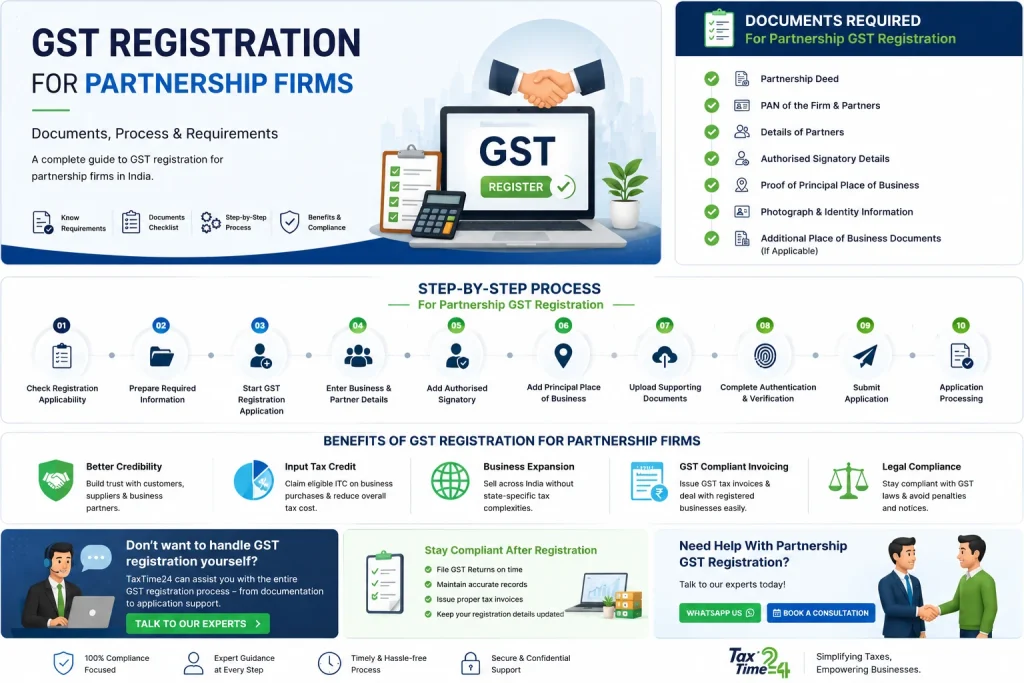
Documents Required for Partnership GST Registration
The exact documents can vary depending on the firm’s circumstances, business premises and authorised signatory. See our GST registration documents guide for a practical checklist.
Commonly required information and documents include:
1. Partnership Deed
The partnership deed is generally used as proof of the constitution of the partnership firm.
2. PAN Details
PAN details of the partnership firm and the relevant partners/promoters are required as part of the registration application.
3. Details of Partners
The registration application requires information relating to the partners/promoters of the partnership firm.
4. Authorised Signatory Details
The firm must provide the required details of its authorised signatory.
5. Proof of Principal Place of Business
Depending on the nature of the premises, supporting documents may include:
- Electricity bill
- Property tax receipt
- Municipal Khata copy
- Rent or lease agreement
- Consent letter
- Other applicable ownership or possession documents
6. Photographs and Identity Information
Photographs and identity-related information may be required for relevant partners and authorised signatories as applicable to the registration process.
7. Additional Place of Business Documents
If the partnership firm has additional business locations, supporting documents may also be required for those premises.
Important: The documents required can vary depending on the firm’s constitution, premises and application details. Always check the current GST portal requirements before submitting an application.
How to Apply for GST Registration for a Partnership Firm
The GST registration application is submitted through the GST portal.
Here is a simplified overview of the process.
Step 1: Check Registration Applicability
First, determine whether the partnership firm is required to register under GST or whether voluntary registration is being considered.
Step 2: Prepare the Required Information
Keep the firm’s PAN, partnership deed, partner details, authorised signatory information and business-premises documents ready before beginning the application.
Step 3: Start the GST Registration Application
The applicant can begin a new registration application on the GST portal by providing the required preliminary details.
Step 4: Enter Business and Partner Details
The application includes sections for business details and promoter/partner information.
The firm’s legal name, constitution of business and relevant partner information must be entered accurately.
Step 5: Add the Authorised Signatory
The details of the authorised signatory are provided as part of the application.
The authorised signatory will be responsible for completing the relevant verification and submission requirements.
Step 6: Add the Principal Place of Business
Details of the firm’s principal place of business must be provided along with the applicable supporting documents.
If the firm has additional places of business, those details may also need to be provided.
Step 7: Upload Supporting Documents
Upload the required documents in the format and size prescribed by the GST portal.
Make sure that documents are:
- Clear and readable
- Correctly associated with the application
- Current where applicable
- Consistent with the information entered in the application
Step 8: Complete Authentication and Verification
Depending on the application and applicable requirements, authentication may involve Aadhaar-based authentication or other verification procedures.
For partnership firms, the GST portal provides specific Aadhaar-authentication requirements involving the primary authorised signatory and a partner in applicable cases.
Step 9: Submit the Application
After completing the required information and verification, the application is submitted through the GST portal using the applicable submission method.
Step 10: Application Processing
Submission of the application does not automatically mean that registration has been granted.
The application is processed by the appropriate tax authority. If clarification or additional information is requested, the applicant must respond through the prescribed GST process.
Once the application is approved, the GST registration certificate and GSTIN are issued.
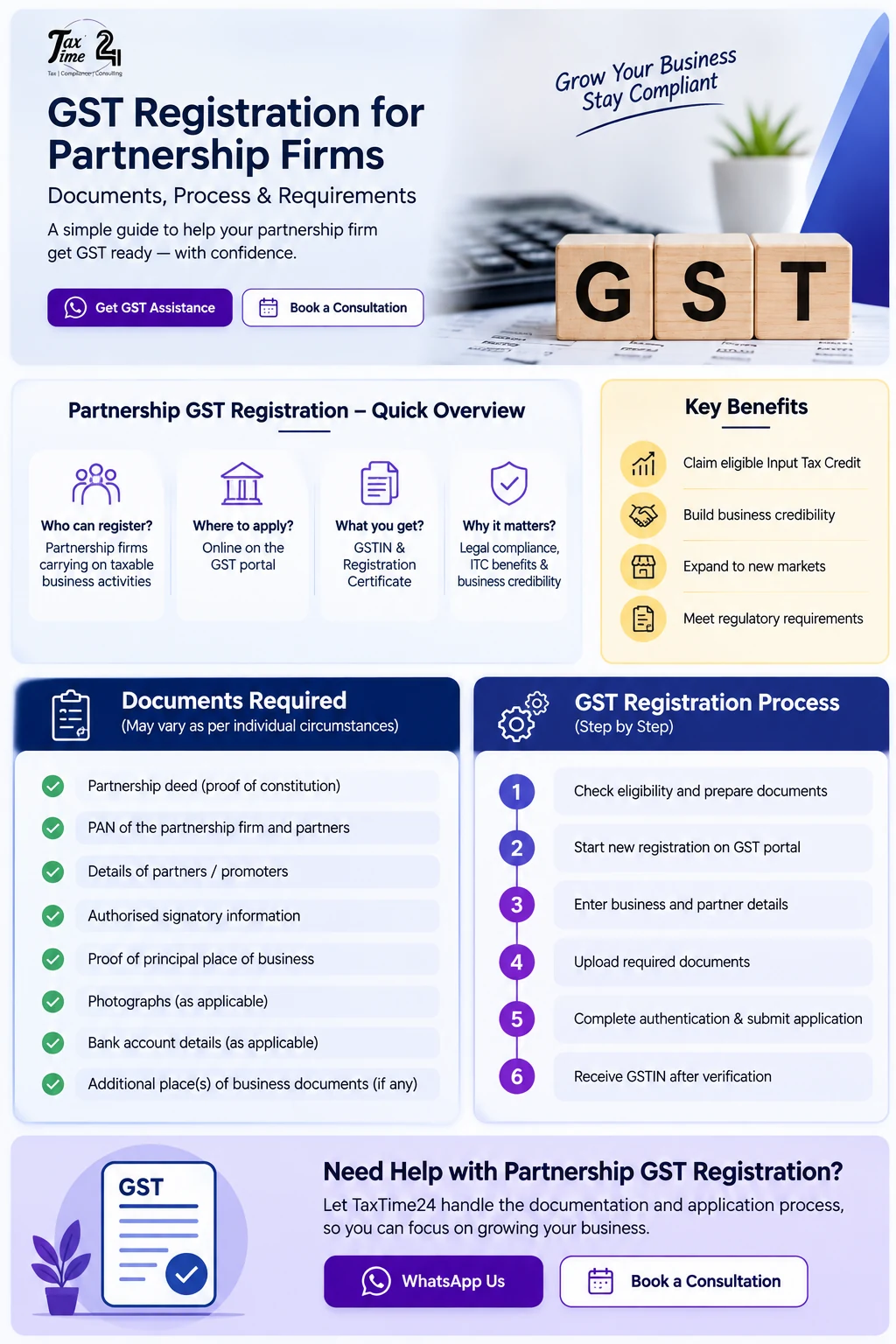
Benefits of GST Registration for a Partnership Firm
GST registration can provide several practical benefits depending on the firm’s business model.
1. Ability to Issue GST Tax Invoices
A registered partnership firm can issue GST-compliant tax invoices where applicable, which can be important when dealing with GST-registered customers.
2. Eligible Input Tax Credit
A registered business may be able to claim eligible Input Tax Credit on GST paid on business purchases, subject to the applicable conditions and restrictions.
This can help reduce the effective tax cost of eligible business expenses.
3. Better Business Credibility
GST registration can provide a more formal business identity when dealing with customers, suppliers and other businesses.
4. Support for Business Expansion
GST registration can be relevant when a partnership firm expands its customer base, enters new markets or works with businesses that expect GST-compliant invoicing.
5. Regulatory Compliance
Where registration is mandatory, completing the registration process helps the partnership firm meet its GST obligations and avoid issues associated with non-compliance.
What Happens After GST Registration?
Getting a GSTIN is only the beginning of GST compliance.
Once registered, a partnership firm may need to manage ongoing GST responsibilities depending on its registration type and business activities.
These may include:
- Issuing appropriate tax invoices
- Maintaining proper records
- Filing applicable GST returns
- Reporting taxable supplies correctly
- Maintaining documentation supporting Input Tax Credit claims
- Paying GST within the applicable timelines
- Updating registration details when required
- Responding to GST notices or clarification requests when applicable
The firm’s actual compliance requirements depend on its business activities, registration type and applicable GST provisions.
Common Mistakes to Avoid During Partnership GST Registration
A few simple mistakes can create unnecessary delays or clarification requests.
Incorrect business details
Make sure the legal name, PAN and partnership details match the supporting documents.
Incomplete address documentation
The proof submitted for the principal place of business should correspond with the nature of the premises.
Incorrect partner or authorised signatory information
Review the details carefully before submitting the application.
Poor-quality document uploads
Documents should be clear and readable and should meet the GST portal’s prescribed requirements.
Assuming registration is automatic
Submitting the application does not itself mean that GST registration has been approved. The application is subject to processing and verification.
Need Help With Partnership GST Registration?
GST registration can look straightforward until you start dealing with documentation, business details, verification and portal requirements.
TaxTime24 can assist partnership firms with:
- Understanding the registration requirements
- Preparing the required documentation
- Completing the GST registration application
- Supporting the verification process
- Addressing clarification requirements where applicable
- Understanding ongoing GST compliance’
Want to get your partnership firm’s GST registration started?
Frequently Asked Questions
Is GST registration mandatory for every partnership firm?
No. Registration depends on the firm’s turnover, nature of supplies and other applicable provisions. A partnership firm should evaluate its specific circumstances before deciding whether registration is mandatory.
What documents are required for partnership GST registration?
Common documents include the partnership deed, PAN and partner details, authorised signatory information and proof of the principal place of business. Additional documents may be required depending on the firm’s circumstances.
Is a partnership deed required for GST registration?
The GST portal’s document checklist identifies the partnership deed as proof of constitution for a partnership firm.
Can a partnership firm register voluntarily under GST?
Yes, voluntary registration may be available where the firm is not otherwise liable to register, subject to the applicable GST provisions and consequences of voluntary registration.
How long does GST registration take?
The processing time can vary depending on the application, verification requirements and whether the tax authority requests clarification or additional information.
What happens if the GST officer asks for clarification?
If clarification is requested, the applicant can respond through the GST portal within the prescribed process and timeframe, providing the requested explanation or supporting documents.
Does GST registration mean the firm has no further compliance requirements?
No. After registration, the partnership firm must comply with applicable GST requirements, which can include invoicing, record-keeping, return filing and payment obligations.
Can TaxTime24 help with partnership GST registration?
Yes. TaxTime24 can assist with the registration process, documentation and related GST compliance requirements.
How Long Does Partnership GST Registration Take?
The time required for GST registration depends on the completeness of the application, verification requirements and whether the tax officer requests clarification or additional information.
Applications with complete and consistent information can generally move through the process more smoothly, while clarification requests can extend the overall timeline.
For this reason, the partnership deed, PAN details, partner information, authorised signatory details and business-premises documents should be checked carefully before submission.
Related GST Guides
GST Registration for Private Limited Companies
Learn about the GST registration process and requirements applicable to private limited companies.
GST Registration for Sole Proprietorship
Understand GST registration considerations for proprietorship businesses.
GST Registration Documents
See a practical checklist of documents commonly required for GST registration.
GST Registration for Amazon & E-commerce Sellers
Learn about GST registration considerations for businesses selling through online marketplaces.
Conclusion
GST registration is an important part of operating a compliant partnership firm when registration is applicable to the business.
The process involves more than simply obtaining a GSTIN. The partnership needs to provide accurate business and partner information, submit the appropriate documents, complete the required verification and then manage its ongoing GST obligations.
If you’re unsure whether your partnership firm needs GST registration or you want assistance with the application, TaxTime24 can help you navigate the process and get the required work completed correctly.
Need help with partnership GST registration?