GST registration requires the applicant to provide information and supporting documents through the GST registration application. The exact documents depend on the type of taxpayer, business structure, authorised signatory and the nature of the premises used for business.
A proprietorship, partnership firm, LLP and Private Limited Company do not always submit exactly the same set of documents. The GST registration application should therefore be prepared according to the actual structure and circumstances of the business.
This guide explains the commonly required documents for GST registration in India and what businesses should keep ready before starting their application.
What Documents Are Required for GST Registration?
The documents required for GST registration generally relate to four areas:
- PAN and identity details
- Constitution of the business
- Principal place of business
- Proprietor, partners, directors or authorised signatory details
Additional information or documents may be required depending on the business structure and circumstances.
The GST registration process requires the applicant to provide PAN, mobile number, email address and State/Union Territory details in the initial registration process, followed by the application and applicable supporting documents.
GST Registration Documents Checklist
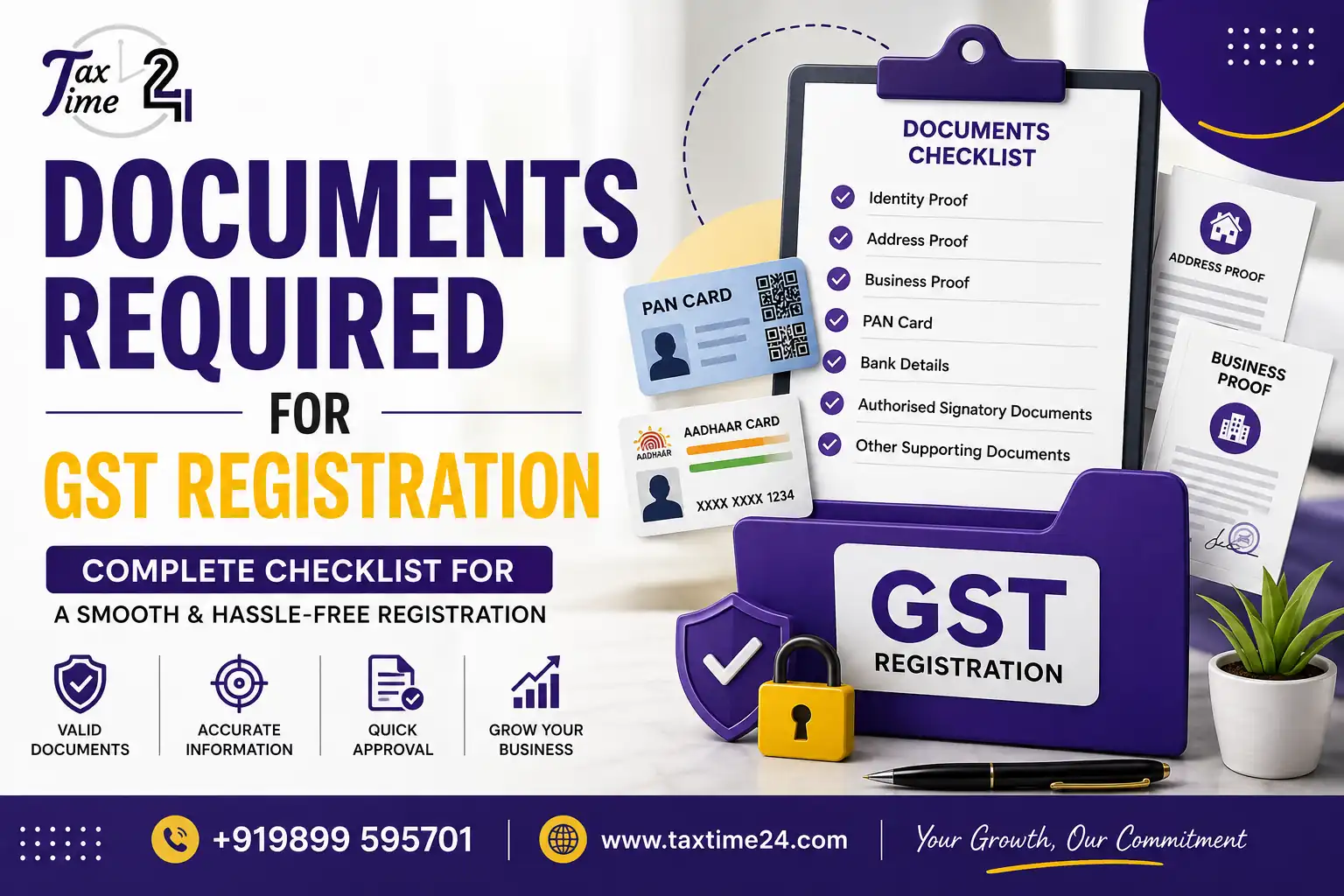
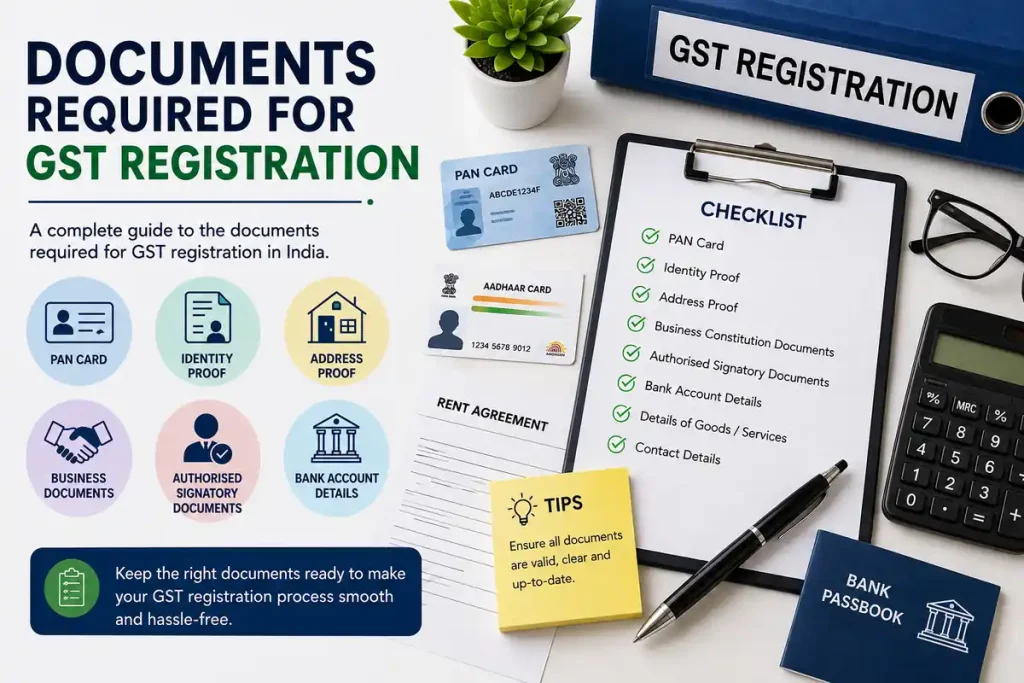
Before starting the application, keep the following information and documents ready where applicable:
- PAN of the applicant or business entity
- Aadhaar/identity details of the proprietor, partners, directors or relevant authorised persons
- Photograph of the proprietor or relevant persons, where applicable
- Proof of principal place of business
- Proof for additional places of business, where applicable
- Business constitution documents
- Authorised signatory details and proof of authorisation, where applicable
- Bank account information, where required
- Details of goods or services supplied
- Contact details including mobile number and email address
The exact checklist can vary by business structure.
PAN Card for GST Registration
PAN is a fundamental requirement for GST registration.
For a sole proprietorship, the proprietor’s PAN is used because the proprietorship does not have a separate PAN from its proprietor.
For entities such as a Private Limited Company or LLP, the entity’s PAN is used for registration.
The PAN details entered in the application should match the records of the applicant or entity.
Aadhaar and Identity Documents
Identity and authentication details may be required during the GST registration process.
Depending on the taxpayer and applicable process, Aadhaar authentication may be available or required for the relevant persons.
Applicants should ensure that the name and other identity details used during authentication are consistent with their official records.
Photograph
A photograph may be required for the proprietor or other relevant persons as part of the registration application.
The requirement can depend on the taxpayer type and application structure.
Proof of Principal Place of Business
Proof of the principal place of business is one of the most important parts of a GST registration application.
The appropriate document depends on whether the premises are:
- Owned by the applicant
- Rented or leased
- Used with the owner’s consent
- Located in another permitted business arrangement
Common supporting documents can include:
Electricity Bill or Utility Bill
A recent electricity bill or other appropriate utility document may be used where applicable.
Property Tax Receipt
A property tax receipt can be used as supporting evidence in applicable cases.
Municipal or Local Authority Document
Documents issued by a municipal or other competent local authority may be acceptable depending on the circumstances.
Rent or Lease Agreement
Businesses operating from rented or leased premises may provide the applicable rent or lease agreement along with supporting ownership/address documentation where required.
Consent Letter
Where premises are being used with the consent of the owner, an appropriate consent letter and supporting address/ownership evidence may be relevant.
Government-Issued Property Document
A government-issued property document may also be used where appropriate.
Documents for a Sole Proprietorship
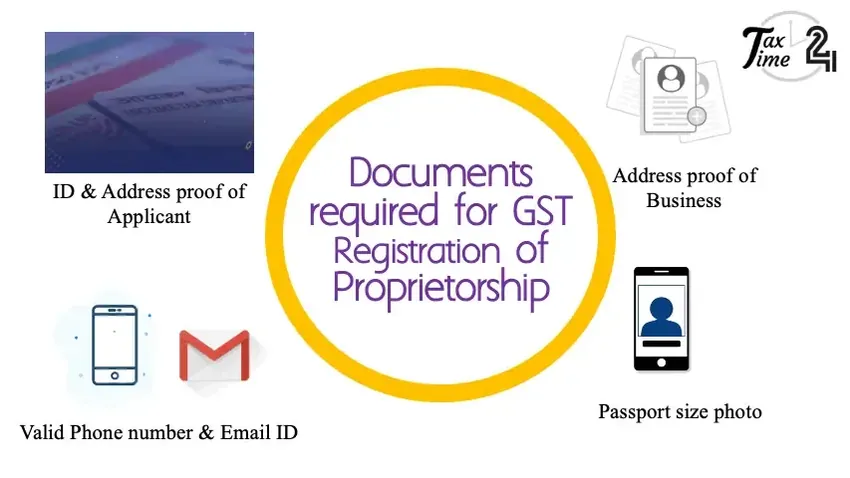
A sole proprietor generally needs to keep ready:
- Proprietor’s PAN
- Proprietor’s identity details
- Photograph, where applicable
- Principal place of business proof
- Additional place of business proof, if applicable
- Bank details, where required
- Business activity and goods/services information
The proprietor does not have a separate PAN for the proprietorship business.
For more detailed guidance, see our GST registration guide for sole proprietorships.
Documents for a Partnership Firm
A partnership firm may commonly need:
- PAN of the partnership firm
- Partnership deed
- PAN and identity details of partners, as applicable
- Photograph/details of relevant persons
- Principal place of business proof
- Additional place of business proof, if applicable
- Authorised signatory details and authorisation
- Bank details, where required
- Details of goods/services supplied
The partnership deed should be clear and consistent with the business details declared in the GST application.
Documents for a Limited Liability Partnership (LLP)
An LLP may commonly need:
- LLP PAN
- Certificate of Incorporation/LLP incorporation document
- LLP agreement, where applicable
- Details of designated partners
- Identity details of relevant persons
- Authorised signatory details and authorisation
- Principal place of business proof
- Additional place of business proof, if applicable
- Bank details, where required
- Goods/services details
The information should match the LLP’s official records.
Documents for a Private Limited Company
A Private Limited Company may commonly need:
- Company PAN
- Certificate of Incorporation
- Details of directors
- Details of authorised signatory
- Proof of appointment/authorisation of the authorised signatory, where applicable
- Principal place of business proof
- Additional place of business proof, if applicable
- Bank details, where required
- Details of goods/services supplied
- Photograph and identity details of relevant persons, where applicable
Companies should also be prepared to complete the applicable Digital Signature Certificate (DSC) process.
For more information, see our GST registration guide for a Private Limited Company.
Documents for an Individual or Freelancer
An individual or freelancer applying for GST registration may commonly need:
- PAN
- Identity details
- Photograph, where applicable
- Principal place of business proof
- Additional place of business proof, if applicable
- Bank details, where required
- Details of goods/services supplied
The exact requirements depend on the nature of the activity and registration application.
Authorised Signatory Documents
Where a person is acting as an authorised signatory for a business entity, appropriate authorisation may be required.
Depending on the business structure, this can include documents such as:
- Letter of authorisation
- Board resolution
- Partner authorisation
- Other applicable proof of appointment or authorisation
The exact document depends on the type of entity and the role of the signatory.
Documents for Additional Places of Business
If a business has more than one place of business, supporting details/documents may be required for the additional premises.
The business should maintain clear records for each location and ensure that the address entered in the application matches the supporting documentation.
Bank Account Details for GST Registration
Bank account information may be required as part of the GST registration or subsequent compliance process.
Businesses should use accurate account details and keep supporting banking information available.
The exact timing and manner of providing bank details can depend on the current GST registration process.
Documents for E-commerce Sellers
E-commerce sellers should prepare the documents applicable to their underlying business structure.
For example, an Amazon seller operating as a sole proprietorship will generally need proprietorship-related documents, while a Private Limited Company selling through an e-commerce platform will need company-related documents.
The marketplace itself does not replace the underlying GST registration requirements.
See our GST registration guide for e-commerce sellers for marketplace-specific guidance.
Documents for Multiple States
GST registration is generally State/UT-specific.
If a business has taxable operations requiring registration in more than one State/UT, the applicable registration requirements should be assessed separately for each location.
Businesses should therefore keep appropriate address and business information ready for each relevant location.
Common Mistakes in GST Registration Documents
1. Using an Outdated Address Proof
The applicant should use appropriate and relevant proof for the declared business premises.
2. Mismatch Between PAN and Application
The PAN and legal name should match the applicable official records.
3. Incorrect Proprietor, Director or Partner Details
Names and identity details should be entered accurately.
4. Incomplete Authorisation
An authorised signatory should have the appropriate appointment or authorisation documentation.
5. Uploading Unclear Documents
Documents should be readable and complete.
6. Using the Wrong Business Constitution Document
A partnership deed, LLP agreement, Certificate of Incorporation or other constitution document should correspond to the actual business structure.
7. Ignoring Additional Places of Business
Where applicable, additional premises should be declared and supported appropriately.
8. Assuming the Same Checklist Applies to Every Business
The documents for a proprietorship are not identical to those for a Private Limited Company or LLP.
How to Prepare Your GST Documents Before Applying
A simple preparation checklist can make the registration process easier.
Before starting the application:
- Confirm the correct PAN.
- Confirm the legal/business name.
- Confirm the principal business address.
- Identify whether the premises are owned, rented or used with consent.
- Keep address proof ready.
- Collect constitution documents.
- Confirm proprietor/partner/director details.
- Identify the authorised signatory.
- Keep authorisation documents ready where applicable.
- Keep digital copies of the documents in readable quality.
- Check that names and addresses are consistent across documents.
- Identify the goods/services the business supplies.
What Happens If GST Documents Are Incorrect?
Incorrect or incomplete information can result in a clarification request or delay in processing.
The GST registration rules provide for examination of the application and accompanying documents. Where the application is deficient or clarification is required, the proper officer can issue a notice requesting clarification, information or documents.
If clarification is requested, the applicant should respond through the GST Portal within the prescribed period.
This is why checking documents before submission is important.
GST Registration Documents – FAQs
What are the main documents required for GST registration?
The common requirements include PAN, identity details, proof of principal place of business, business constitution documents and authorised-signatory details where applicable. Additional documents depend on the taxpayer’s structure and circumstances.
Is PAN mandatory for GST registration?
Yes. PAN is a core requirement for GST registration.
Is Aadhaar required for GST registration?
Aadhaar authentication requirements depend on the taxpayer and applicable GST registration process. Applicants should follow the current GST Portal authentication process applicable to their application.
What address proof is accepted for GST registration?
Depending on the circumstances, documents such as an electricity/utility bill, property tax receipt, municipal document, rent/lease agreement, consent letter or other appropriate property/address document may be used.
What documents are required for GST registration of a proprietorship?
Common requirements include the proprietor’s PAN and identity details, photograph where applicable, principal place of business proof and relevant business information.
What documents are required for GST registration of a partnership firm?
Common requirements include the firm’s PAN, partnership deed, partner details, authorised signatory information and business address proof.
What documents are required for GST registration of a Private Limited Company?
Common requirements include company PAN, Certificate of Incorporation, director details, authorised-signatory documents and principal place of business proof.
What documents are required for GST registration of an LLP?
An LLP may need its PAN, incorporation documents, LLP agreement where applicable, designated partner details, authorised signatory information and business address proof.
Do I need a rent agreement for GST registration?
Not in every case. The appropriate address proof depends on how the premises are owned or occupied. A rented or leased premises may require the relevant rent/lease documentation along with applicable supporting evidence.
Can I use a residential address for GST registration?
A residential premises may be used as a principal place of business where the circumstances and applicable requirements permit it. Appropriate address/occupancy proof should be maintained.
Can I apply for GST registration without a business premises?
The answer depends on the actual nature of the business and the address arrangement. GST registration requires the relevant place-of-business information and supporting documents as applicable.
What happens if the GST officer asks for additional documents?
If clarification or additional documents are requested, the applicant should respond through the GST Portal within the prescribed period.
Get Help With GST Registration Documents
Preparing the right documents before starting the GST application can save time and reduce avoidable clarification requests.
TaxTime24 can help businesses understand the documents required for GST registration based on their business structure and assist with the registration process.
Whether you operate as a:
- Sole proprietor
- Partnership firm
- LLP
- Private Limited Company
- Individual or freelancer
- E-commerce seller
we can help you prepare for GST registration with the appropriate documentation.
Get in touch with TaxTime24 for GST registration assistance.
Important Note
GST registration requirements, document formats, authentication procedures and compliance rules can change through amendments, notifications and updates issued by the Government/GST authorities.
This article is for general information and should not be treated as personalised tax or legal advice. The exact documents required should be assessed according to the applicant’s current circumstances and the applicable GST Portal requirements.