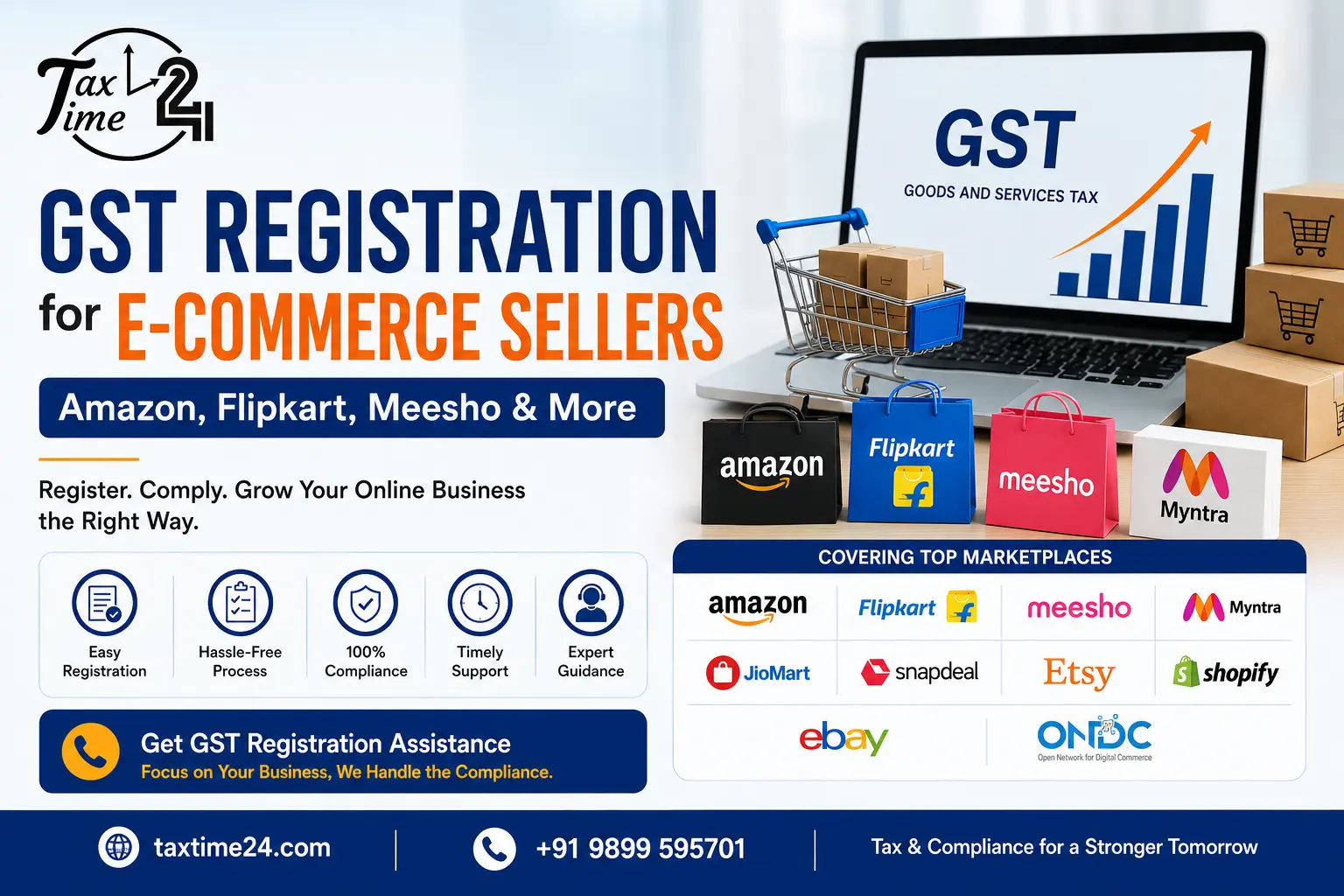
Selling products online through marketplaces such as Amazon, Flipkart and Meesho can help a business reach customers across India. But before scaling an e-commerce business, sellers should understand their GST registration and compliance requirements.
GST registration for e-commerce sellers depends on the nature of supplies, turnover, the platform involved and the applicable GST provisions. The rules can differ depending on whether the seller supplies goods or services and how the marketplace handles the transaction.
This guide explains GST registration for e-commerce sellers, including Amazon, Flipkart, Meesho and other popular platforms. It covers eligibility, documents, registration process, fees, GSTIN and important compliance requirements.
Do E-commerce Sellers Need GST Registration?
An e-commerce seller should not determine GST registration requirements solely from the name of the marketplace.
GST registration depends on the applicable provisions and the seller’s circumstances.
For certain suppliers making supplies through an electronic commerce operator that is required to collect tax at source under Section 52, the GST law contains specific registration provisions.
There are also specific provisions and exemptions that can affect particular categories of suppliers. Therefore, an online seller should assess the type of supply, turnover, marketplace arrangement and applicable GST rules before starting or expanding sales.
GST Registration for Amazon Sellers
Amazon is one of the most widely used marketplaces for sellers in India.
Businesses selling taxable goods through Amazon should evaluate their GST registration requirement based on the applicable GST provisions and their specific selling arrangement.
What does an Amazon seller need for GST registration?
Depending on the business structure, common requirements may include:
- PAN
- Identity and contact details
- Business address proof
- Bank account details
- Photograph of the proprietor or applicable authorised person
- Business constitution documents where applicable
- Details of the goods or services supplied
An Amazon seller should also ensure that the information used for GST registration is consistent with the business information used for marketplace operations.
GST Registration for Flipkart Sellers
Flipkart sellers should similarly determine their GST obligations based on their business structure, products, turnover and applicable e-commerce provisions.
The GST registration process itself is completed through the GST Portal, while marketplace-related requirements are handled separately with Flipkart.
Keeping GST and marketplace business details consistent can help reduce avoidable compliance issues.
GST Registration for Meesho Sellers
Meesho has become an important platform for online sellers, particularly small businesses and product-based entrepreneurs.
A Meesho seller should assess whether GST registration is required based on the applicable GST provisions and the nature of the business.
Where registration is required, the seller needs to complete the GST registration process and maintain the applicable GST compliance afterward.
GST Registration for Myntra Sellers
Businesses selling eligible products through Myntra should evaluate their GST registration requirements based on their business model and the applicable provisions.
Fashion, apparel and other marketplace sellers should maintain proper records of marketplace sales, invoices and related business expenses.
GST Registration for JioMart Sellers
JioMart sellers should also consider GST registration based on their business activities and the GST provisions applicable to their transactions.
The seller’s legal structure, product category and marketplace arrangement may affect the compliance requirements.
GST Registration for Snapdeal Sellers
Snapdeal sellers should assess GST registration based on the nature of their supplies and applicable GST requirements.
As with other marketplaces, proper documentation and accurate business information are important when applying for GST registration.
GST Registration for Etsy Sellers
Sellers using Etsy or other online marketplaces should consider GST implications based on whether they are supplying goods domestically or making other types of supplies, including transactions involving customers outside India.
Cross-border and export-related transactions can involve additional GST considerations, so sellers should evaluate their specific circumstances.
GST Registration for Shopify Sellers
Shopify operates differently from a marketplace such as Amazon or Flipkart because businesses can use Shopify to operate their own online store.
A business selling through its own website should therefore assess GST registration under the provisions applicable to its own supplies. The GST framework also distinguishes an e-commerce operator from a supplier selling its own products through its own website.
GST Registration for eBay Sellers
Businesses selling through eBay should similarly evaluate their GST registration and compliance requirements according to the nature and location of their supplies.
Where international sales are involved, additional GST and export-related rules may need to be considered.
GST Registration for ONDC Sellers
Businesses selling through ONDC-connected networks should assess GST requirements based on their business structure, products/services and transaction model.
The fact that a business operates through a digital commerce network does not remove the need to evaluate its underlying GST obligations.
Documents Required for GST Registration for E-commerce Sellers
The exact documents depend on the seller’s business structure.
Common documents can include:
PAN
The PAN of the proprietor, company, LLP or other applicable entity is required.
Identity and Contact Details
The applicable mobile number, email address and identity details are required for registration.
Business Address Proof
Depending on the premises, documents may include:
- Electricity bill
- Rent or lease agreement
- Property tax receipt
- Consent letter
- Government-issued property document
Photograph
A photograph of the proprietor or relevant authorised person may be required.
Business Constitution Documents
Depending on the business structure, this could include:
- Certificate of Incorporation
- Partnership deed
- LLP agreement
- Other applicable constitution documents
Bank Details
Bank account information may be required as part of GST registration or subsequent compliance.
Product/Service Details
The applicant needs to provide appropriate information about the goods or services supplied.
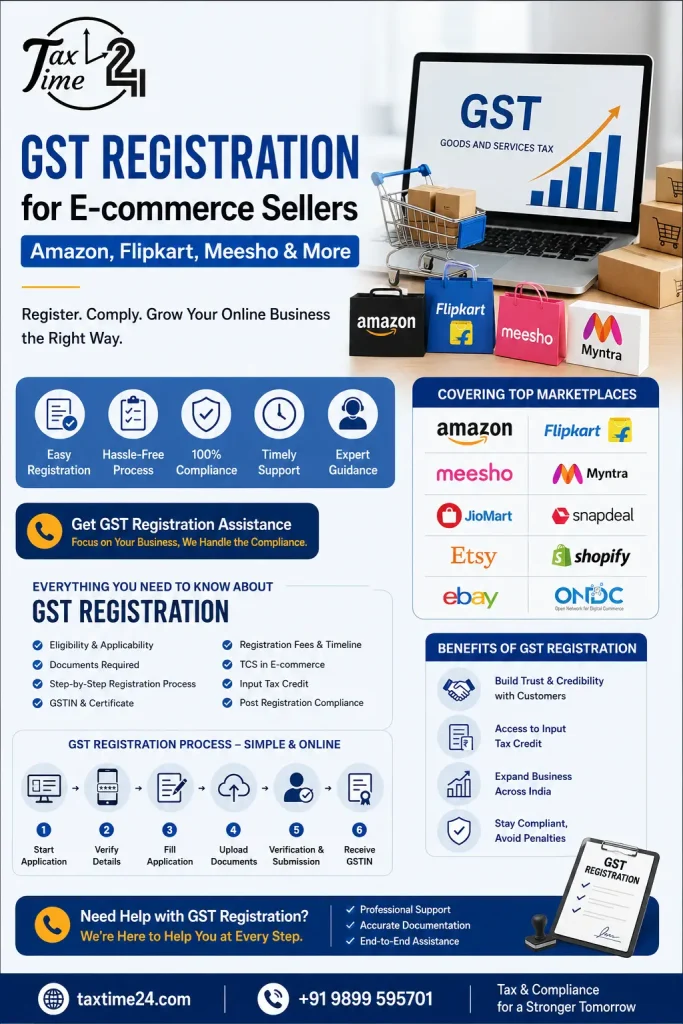
GST Registration Process for E-commerce Sellers
GST registration is completed online through the GST Portal.
Step 1: Start GST Registration
Provide the required PAN, mobile number, email address and State/UT details.
Step 2: Verify Contact Details
Complete the applicable OTP verification and generate the Temporary Reference Number (TRN).
Step 3: Complete the Application
Enter the required information relating to:
- Business
- Proprietor/partners/directors
- Principal place of business
- Additional places of business
- Goods and services
- Bank details
- Authorised signatory
- Other applicable information
The GST Portal confirms that registration is state-wise and the selected State/UT cannot simply be changed later in the application.
Step 4: Upload Documents
Upload the documents applicable to the business and premises.
Step 5: Complete Verification
Complete the applicable Aadhaar authentication and/or other verification requirements.
The GST Portal currently provides Aadhaar authentication workflows for new registrations, with the process depending on the taxpayer and applicable risk parameters.
Step 6: Submit the Application
Review the application carefully and submit it through the appropriate verification method.
An Application Reference Number (ARN) is generated after successful submission.
Step 7: Respond to Clarifications
If the GST authorities request additional information or clarification, respond through the GST Portal within the applicable time.
Step 8: Receive GSTIN
Once approved, the seller can access the GST registration certificate and GSTIN.
GST Registration Fees for E-commerce Sellers
There is no government application fee for a normal GST registration application filed through the GST Portal.
If a professional or consultant handles the registration, professional service charges may apply.
The professional fee may depend on:
- Business structure
- Documentation requirements
- Number of registrations
- Number of business locations
- Complexity of the application
- Clarification or verification requirements
How Long Does GST Registration Take?
The processing time can vary depending on the application, verification requirements and whether clarification is requested.
Complete and consistent documentation can help reduce avoidable delays.
It is better to avoid promising a fixed approval time for every e-commerce seller.
GSTIN and GST Certificate for E-commerce Sellers
After successful registration, the seller receives a GSTIN (Goods and Services Tax Identification Number) for the applicable State/UT.
The seller should verify the GST certificate carefully, including:
- Legal name
- Trade name
- Principal place of business
- GSTIN
- Registration date
- Registration type
- Other applicable details
GST Compliance After E-commerce Registration
GST registration is only the beginning of the seller’s compliance responsibilities.
Depending on the business and registration type, an e-commerce seller may need to:
- Issue appropriate GST invoices
- Maintain sales and purchase records
- File applicable GST returns
- Pay GST within applicable deadlines
- Reconcile marketplace sales
- Maintain records supporting Input Tax Credit
- Keep GST and marketplace records accurate
- Respond to GST notices when applicable
Suppliers making specified supplies through e-commerce operators may also have reporting implications relating to supplies made through the operator. GSTN guidance provides specific GSTR-1 reporting tables for such transactions.
What Is TCS in E-commerce under GST?
E-commerce transactions can involve Tax Collected at Source (TCS) under Section 52 where the relevant conditions apply.
The e-commerce operator and the actual supplier have different roles under the GST framework.
This is particularly important when reconciling marketplace sales with GST returns and accounting records.
The applicable GST treatment depends on the nature of the transaction and whether the e-commerce operator is required to collect TCS.
Can an E-commerce Seller Claim Input Tax Credit?
A GST-registered seller may be eligible to claim Input Tax Credit on eligible business purchases, subject to the conditions and restrictions under GST law.
The seller should maintain proper tax invoices and supporting records and ensure that the applicable conditions for claiming ITC are satisfied.
Common GST Mistakes Made by E-commerce Sellers
Assuming every marketplace seller follows the same GST rule
Different transaction models and types of supplies can produce different GST consequences.
Using outdated GST thresholds
GST registration rules and exemptions can change. Sellers should not rely on old generic threshold statements without checking the current applicable provisions.
Mismatch between GST and marketplace information
The legal name, address and other important information should be kept consistent wherever applicable.
Incorrect business address
The principal place of business should be correctly declared and supported with appropriate documentation.
Poor record keeping
Marketplace orders, cancellations, returns, fees, invoices and tax information should be reconciled properly.
Ignoring GST return filing
Obtaining a GSTIN does not end the seller’s GST obligations. Applicable returns and tax payments must continue to be managed.
Frequently Asked Questions
Do Amazon sellers need GST registration?
GST registration depends on the seller’s circumstances and the applicable GST provisions. Sellers should evaluate their business model, supplies and marketplace arrangement before determining their GST liability.
Do Flipkart sellers need GST registration?
The requirement depends on the applicable GST provisions, nature of supplies and seller’s circumstances.
Do Meesho sellers need GST registration?
A Meesho seller should assess GST registration based on the nature of the business, supplies and applicable GST provisions.
Can I sell online without GST registration?
In some circumstances an online seller may not be required to register, while other situations can trigger registration requirements. The answer depends on the applicable GST provisions and the nature of the seller’s transactions.
What documents are required for e-commerce GST registration?
Common documents include PAN, identity/contact details, business address proof, photograph, bank details and applicable business constitution documents.
How much does GST registration cost for an online seller?
The normal GST registration application does not have a government application fee. Professional charges may apply where a consultant handles the registration.
How long does GST registration take?
Processing varies depending on verification, documentation and whether clarification is required.
What is GSTIN?
GSTIN is the 15-digit Goods and Services Tax Identification Number issued after successful GST registration.
Can e-commerce sellers claim Input Tax Credit?
Eligible GST-registered sellers may claim Input Tax Credit subject to the applicable conditions and restrictions.
Is GST filing required after e-commerce GST registration?
Registered sellers generally have ongoing GST compliance requirements, which may include applicable return filing, tax payment and record maintenance.
Get GST Registration Assistance for Your E-commerce Business
Starting an online business is exciting, but GST compliance can become complicated as sales increase across marketplaces and States.
TaxTime24 can help e-commerce sellers with GST registration and related compliance, including documentation, application support and follow-up.
Whether you sell through Amazon, Flipkart, Meesho, Myntra, JioMart or another online platform, we can help you understand the registration process and work toward a compliant setup.
Businesses operating under different structures may have different GST requirements. See our guide to GST registration for a partnership.
Important Note
GST registration requirements, thresholds, e-commerce provisions and compliance rules can change through legislation, notifications and government updates. This article is intended for general information and should not be treated as personalised tax advice. The GST position of an e-commerce business should be assessed based on its actual circumstances and the applicable provisions.